
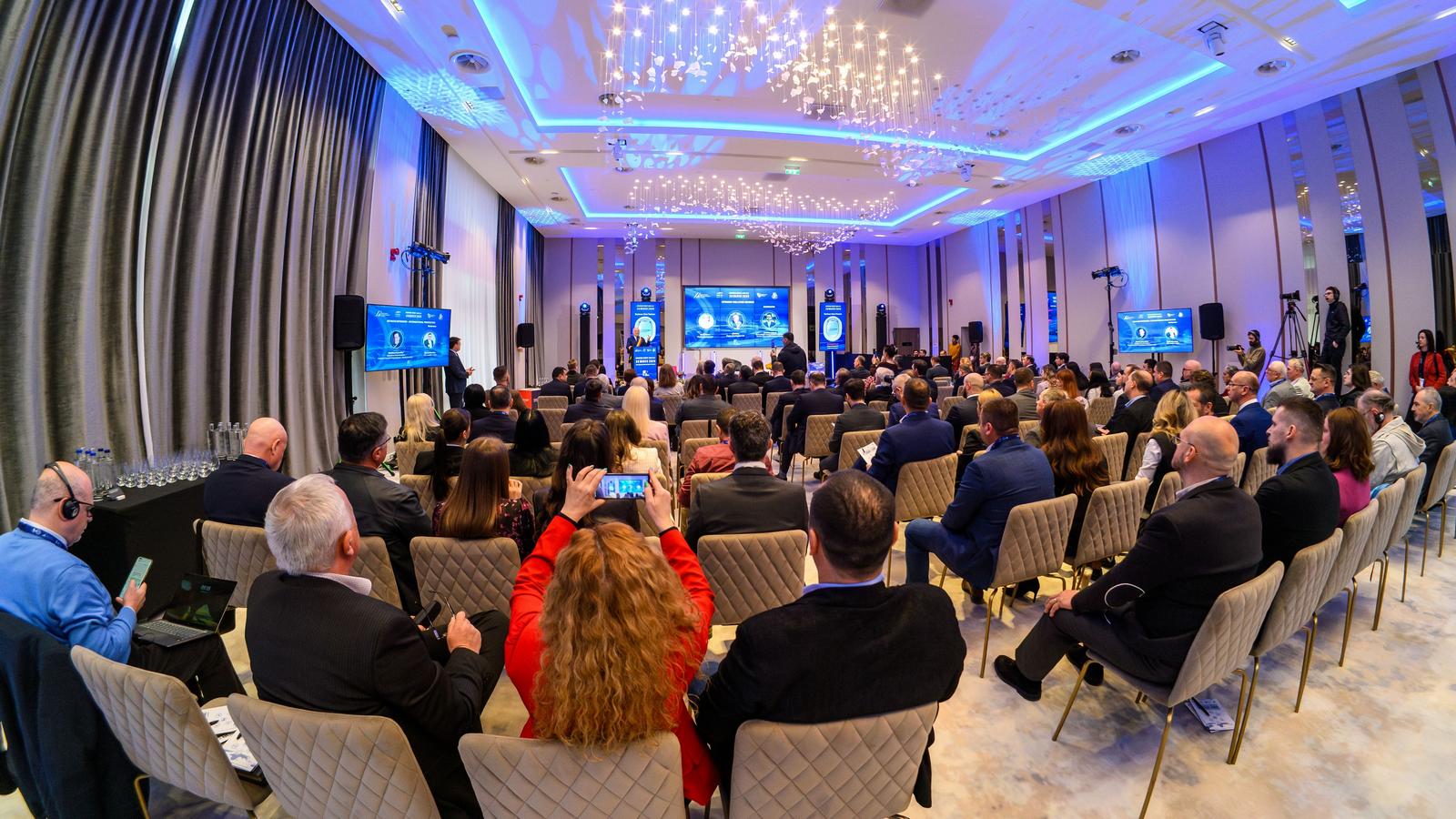
Aviadege coverage of the fifth edition of Aviation-Event, held on March 20, 2026, at Cluj “Avram Iancu” International Airport.
A Fifth Edition, and a Changed Industry
Aviation-Event 2026 CLJ marked the fifth consecutive edition of the conference in Romania, organized by Aviation-Event in partnership with “Avram Iancu” Cluj International Airport and the Cluj County Council. Around 200 decision-makers and more than 30 speakers gathered in Cluj-Napoca. Airline executives, airport operators, regulators, infrastructure providers, and aviation media. The day was opened by Maria Forna, Prefect of Cluj County, and Emil Boc, Mayor of Cluj-Napoca, with the welcome session moderated by José Ramón Bauzá, former MEP and Honorary Member of the Aviation-Event Supervisory Board.
David Ciceo, Director General of Cluj International Airport, delivered the opening keynote. “Aviation-Event CLJ has become a benchmark for the civil aviation ecosystem, both regionally and internationally,” Ciceo said, framing the day around international cooperation and sustainable development. Matthew Cornelius, Executive Vice President of ACI North America, then offered the transatlantic perspective, followed by a leadership keynote from Ian Malin, Chief Commercial Officer of Wizz Air, moderated by Rüdiger Kiani-Kress of WirtschaftsWoche.
Marcel Riwalsky, CEO of Aviation-Event, opened the day alongside Ciceo, framing the fifth edition as a milestone in the partnership between the organization and Cluj International Airport. Peter Baumgartner, Chairman of the Aviation-Event Supervisory Board and former CEO of Etihad Airways, delivered the wrap-up.
Three thematic panels structured the rest of the day. Investment and Governance brought together airport leaders from Salzburg (Bettina Ganghofer), Tallinn (Riivo Tuvike), and Dakar (Askin Demir), alongside Jakub Małecki of LOT Polish Airlines and Mihai Pătrașcu of Satu Mare Airport. The Innovation panel gathered Thomas Dworczak (CEO Košice Airport and Director of IT Digitalization at Vienna Airport), Gert Taeymans (EVP Europe, ADB SAFEGATE), Iustinian Șovrea (GlobalLogic Romania), Sofia Mari (Athens International Airport), Professor Sorin Eugen Zaharia of the UNESCO Chair at Politehnica Bucharest, and Marius Popescu of the Carpathia airline association. The Aviation National Focus panel closed the day with Bogdan Costăș (TAROM), Cristian Paris (Menzies Aviation), Marius Pandel (AnimaWings), Romeo Vatră (Iași International Airport), and Nicolae Stoica (Romanian Civil Aeronautical Authority).
The venue itself carried part of the argument. Cluj “Avram Iancu” International Airport has grown from 36,000 passengers a year in 1996 to more than 3.58 million in 2025. It is now Romania’s second-busiest airport after Bucharest, and around 65,000 passengers already travel indirectly between Cluj and the United States every year. Ciceo confirmed that a direct US route is being actively worked on, though not before 2030 at the earliest, the timeline on which the runway extension can be delivered. The conference, in other words, was being hosted by an airport whose own trajectory is one of the clearest case studies of the theme on the agenda.
Wizz Air’s Pivot: Zero Flights to the Middle East
The most candid moment of the day came from Wizz Air. Jet fuel had hit $1,756 per metric ton, up from roughly $600 a month earlier. In that environment, Ian Malin laid out a strategic realignment that would have looked unthinkable a year ago. “We pulled out of Abu Dhabi. As of right now, we are flying zero flights to the Middle East. Zero,” Malin told the audience. Twelve aircraft and 500 crew were redeployed, most of them to Italy and Spain, with knock-on capacity added across Central and Eastern Europe, the Black Sea, and Albania.
The financial armor behind that pivot is fuel hedging. Wizz Air is 86 percent hedged for the fiscal year and 71 percent for the next quarter, with expected consumption protected at a price closer to $700. More than 70 percent of the fleet is now A321neo. The Pratt and Whitney powered metal engine defect that grounded 55 aircraft has been worked down to roughly 30, with total fleet size at 261. As to whether focus had moved from efficiency to resilience, Malin was direct. “Indeed, indeed. Laser-focused now on this reliability point.” The US market is being handled through charters rather than scheduled flights.
The Sentient Tarmac
Gert Taeymans of ADB SAFEGATE took the room through a quieter but equally radical shift. The airfield, historically the most rigid part of airport infrastructure, is becoming a sensor network. Airfield lights are being turned into sensing points that feed automated guidance systems and Foreign Object Debris detection. “Our vision is really that in 10 years from now, a stand will be completely automatically managed from stand entry, the handling of the aircraft, until pushback,” Taeymans said.
Athens: Rhythm, Flow, and Light
Sofia Mari presented the clearest physical expression of the industry’s bet on the future. Athens International Airport has resumed and accelerated its phased expansion, now targeting a 50 million passenger capacity. The program includes a new multi-story car park with over 3,000 additional spaces, a naturally ventilated seven-floor building, a Northwest apron expansion, and a terminal expansion that will increase airport spaces by more than 70 percent. The architectural philosophy rests on three ideas. Rhythm, flow, and light. The centerpiece, the North Oculus, is designed as the commercial heart of the expanded airport, flooded with natural light.
The AI Imperative
Professor Sorin Eugen Zaharia of the UNESCO Chair “Engineering for Society” traced the arc from the first commercial flight in 1914 to the algorithmic skies now emerging. The point was scale. The industry is moving from thousands of aircraft movements toward hundreds of thousands once advanced air mobility, drones, and vertiports are factored in. Machine learning for predictive maintenance. Optimization algorithms for A-CDM. Computer vision for security. Zaharia also linked AI directly to sustainability. Optimization produces lower emissions.
The Human Element
Iustinian Șovrea of GlobalLogic Romania, part of Hitachi, grounded the technology conversation in people. “Our core philosophy is to have the human being in the middle,” he said. The push toward robotic baggage handling, drones, and wheelchair automation is not primarily about efficiency. It is about labor reality. A baggage loader moves roughly ten tons of weight per shift. That is work the industry can no longer staff, and should no longer ask people to do.
Biometrics and the Regulatory Gap
The day’s final thematic thread was seamless travel. Matthew Cornelius of ACI North America cited the US Customs and Border Protection Enhanced Passenger Processing program as proof that biometrics can resolve the chronic arrivals bottleneck when staffing alone cannot. Europe has the technology. What it lacks is regulatory alignment and public trust. Harmonizing disparate national regulatory schemes will likely remain difficult for years.
Romania’s Moment, and Its Risk
Marius Popescu, President of the Carpathia airline association, was blunt about the market. Romanian passengers are extremely price-sensitive, which forces innovation toward doing more with less without compromising safety. Bogdan Costăș of TAROM, Cristian Paris of Menzies Aviation, Marius Pandel of AnimaWings, Romeo Vatră of Iași International Airport, and Nicolae Stoica of the Romanian Civil Aeronautical Authority all pointed to the same structural tension. European funds have delivered a wave of infrastructure improvements, and Romania can become a stronger regional hub. The risk is the gap between physical buildout and the technology layer needed to run it.
Conclusion
Aviation-Event CLJ 2026 did what its fifth edition needed to do. It convened the people actually making the decisions, and it let them speak candidly about a year that has tested every assumption. Strategic retreats from peripheral markets. Automated stands. Terminals built around light. AI moving from slide decks into A-CDM. The skies ahead are not simply larger. They are more intelligent, more disciplined, and more resilient.
“Organizing the fifth edition in Cluj-Napoca underlines our commitment to international cooperation and constructive dialogue,” Ciceo said in his closing remarks, confirming the airport’s intent to host the sixth edition in 2027.